Read a detailed critical analysis of “I am a Spark” by Bhupen Hazarika, highlighting its themes of equality, social justice, unity, revolution, and humanism with simple explanations and insights.
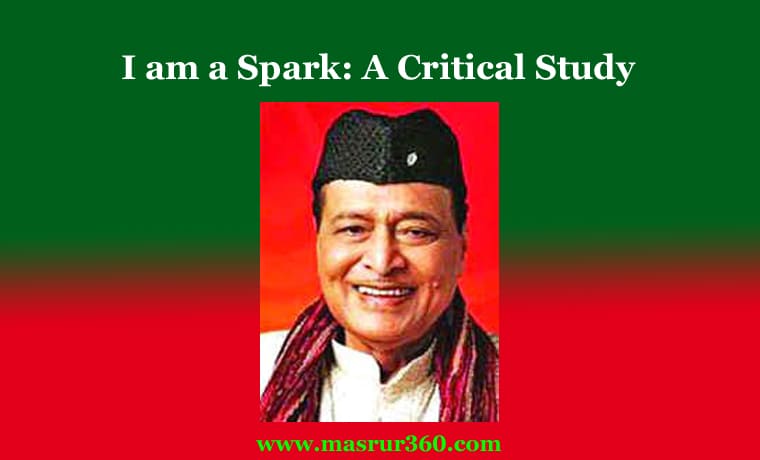
I am a Spark: A Critical Study
Dr. Bhupen Hazarika’s poem “I am a Spark” is a strong and inspiring revolutionary poem that presents the poet’s vision of a new society founded on equality, justice, love, and humanity. The poem reveals the poet’s deep sympathy for the oppressed and suffering sections of society. Using simple yet impactful language, the poet protests against social evils like discrimination, exploitation, untouchability, communalism, and selfishness.
The title of the poem (I am a Spark) carries symbolic significance. By describing himself as a “spark,” the poet portrays himself as a small but energetic force capable of bringing major social change. Though a spark is tiny, it can ignite a massive fire. In the same way, the poet believes that an awakened person can inspire a great revolution in society. His reference to the “fire age” suggests a time of struggle, awareness, and resistance against injustice.
Social revolution is one of the central themes of the poem. The poet openly condemns the “social leeches” who exploit others for their own selfish benefit. These people live by taking advantage of the labour, rights and emotions of the weak and helpless. The poet’s wish to create weapons from “human bones” is symbolic rather than literal. It represents his burning anger against injustice and his strong desire to eliminate evil and exploitation from society. This harsh imagery highlights the intensity of his protest against oppression.
Equality is another major idea in the poem. The poet dreams of building a “heaven of equality” where all people can live with dignity and enjoy equal opportunities for growth and happiness. He wants to destroy the “wall of discrimination” that separates people on the basis of caste, religion, class and social identity. According to him, real humanity can flourish only in a society free from inequality and prejudice.
The poem also conveys a message of unity, love and brotherhood. In the lines:
“Hindu, tribal, suppressed
Muslim, backward, oppressed”
the poet refers to different communities and marginalized groups. Instead of dividing people by religion or identity, he points out that all oppressed people experience the same pain and suffering. His desire to “make love flow through the hearts of all” reflects his belief in universal love, harmony and mutual understanding. He imagines a society free from hatred, communalism and narrow-mindedness.
Another significant aspect of the poem is the poet’s dream of a “new homeland.” This homeland is not just a physical land but an ideal society based on peace, justice and human dignity. In this ideal world, there will be no exploitation in the name of religion, no untouchability and no oppression of the poor. The neglected and downtrodden people will regain their rights, and every individual will be treated with kindness and respect.
The language of the poem is straightforward, emotional and powerful. Bhupen Hazarika makes effective use of symbolism and revolutionary images to communicate his ideas strongly. The repeated emphasis on equality, love and justice increases the emotional strength of the poem. The tone of the poem is passionate, rebellious and hopeful throughout.
The poem by Bhupen Hazarika also reflects the poet’s humanistic outlook. He firmly believes that social progress can be achieved through unity, equality and love among people. His thoughts are universal and go beyond the boundaries of caste, religion or nationality. Through this poem, he encourages readers to oppose injustice and contribute towards building a fair and humane society.
To conclude, “I am a Spark” is an inspiring and socially aware poem that calls for transformation in society. Through symbolic expressions and emotional language, Dr. Bhupen Hazarika expresses his dream of a world free from hatred, oppression and discrimination. The poem ultimately conveys a powerful message of equality, humanity, unity and hope for a better future.
You May Like: সামাজিক মাধ্যম আৰু বর্তমান সমাজত ইয়াৰ প্ৰভাৱ